 Jordan Richter
It's 7:40 bright and early on a Monday, and nobody in your office can open the shared drive. You call the IT company you use when things break, and the earliest they can send someone is Wednesday. Your office manager spends the morning restarting the server and fielding questions from the floor. By noon, orders are behind, and nobody knows whether last night's backup ran.
This post covers seven signs your business has outgrown break-fix IT, what changes with managed IT and cybersecurity, and what it means for St. Louis businesses.
When does a business need managed IT services?
Most small businesses start with break-fix IT. You call a technician when something breaks and pay for the hours. That works when you have a few computers and little to protect. It stops working when downtime costs you orders, when customers ask about your security, or when the same problems keep returning.
Managed IT and cybersecurity replaces the per-call model with a monthly fee. Your provider monitors, maintains, and protects your systems before something breaks. The more of the signs below you recognize, the more break-fix is costing you in time, risk, and unplanned spend.
Signs you've outgrown break-fix IT support
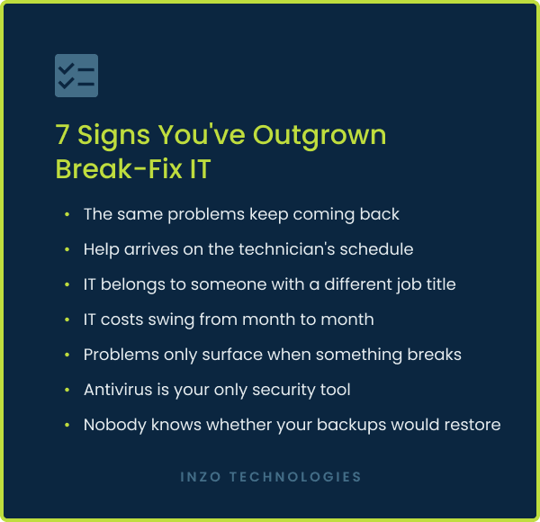
1. The same problems keep coming back
The printer drops off the network again. The same laptop freezes every few weeks. Under break-fix, a technician fixes the symptom and bills for the visit. Nobody is paid to find the root cause, so the problem returns and you pay again. A managed provider absorbs the cost of repeat problems, which gives them a reason to fix the cause the first time.
2. Help arrives on the technician's schedule, not yours
Break-fix providers juggle many customers, often with no set response commitment. When your server goes down on a Tuesday, you wait behind everyone who called first. After 5 p.m. or on a weekend, you may wait until the next business day. Every hour of waiting is an hour your team can't take orders, ship product, or bill clients.
3. IT belongs to someone with a different job title
Your office manager resets passwords. Your controller picks the next firewall. Your operations lead is the only one who knows where the router is. IT pulls these people away from the jobs you hired them to do. When one of them is out, nobody knows the passwords or who to call. Your whole IT setup lives in one person's head.
4. IT costs swing from month to month
A quiet month costs almost nothing. Then a server fails, and you get a bill for a weekend of emergency labor plus hardware you never budgeted for. Break-fix pricing also rewards putting off maintenance, since every visit costs money. Skipped updates and aging hardware turn into bigger, more expensive failures later.
How exposed is your business to a cyberattack?
5. Problems only surface when something breaks
Between service calls, nobody watches your systems. A backup job can fail for weeks without anyone noticing. A disk fills up. A security patch sits uninstalled on a server that faces the internet. Break-fix finds these problems after they cause an outage. Managed IT uses around-the-clock monitoring to catch them while they're still small.
6. Antivirus is your only security tool
Antivirus looks for known malicious files. It does little against a stolen password or a convincing email asking your bookkeeper to wire money. Business email compromise (BEC), a scam where attackers pose as a vendor or executive to redirect payments, cost U.S. victims more than $3 billion in 2025. That figure comes from the FBI's Internet Crime Complaint Center (IC3), where victims report online fraud, in its 2025 Internet Crime Report. Layered security adds multi-factor authentication (MFA), a second proof of identity at login, plus email filtering and 24×7 monitoring.
7. Nobody knows whether your backups would restore
Ask when your backups last ran and when anyone last tested a restore. If nobody knows, you'll find out the day you need them. Ransomware, malicious software that locks your files until you pay, can also encrypt backups stored on the same network. A backup you have never restored is a guess. Managed data protection includes regular restore testing, so recovery is a process you've already practiced.
What changes when you switch from break-fix to managed IT?
The incentive flips. Under break-fix, your provider earns more when things break. Under a managed agreement, your provider earns the same fee either way, so preventing problems is how they protect their margin. That's why managed agreements center on monitoring, patching, and planning instead of emergency visits.
Inzo Technologies® delivers managed IT and cybersecurity as one all-inclusive program for an all-in monthly fee. It includes unlimited remote and onsite managed IT support, after-hours response, network monitoring, and patch management. A 24×7 U.S.-based Security Operations Center (SOC), a team that watches for signs of attack around the clock, handles security operations and monitoring. We also verify your backups, test restores through data protection and recovery, and meet with your leadership each quarter to plan ahead.
Cybersecurity risks for St. Louis businesses
Victims in Missouri filed 14,087 complaints with the IC3 in 2025 and reported $233,933,401 in losses, according to the same FBI report. Missouri ranked 22nd among states in both complaints and losses. Those figures include individuals as well as businesses, and they count only what victims chose to report.
If an attack exposes customer or employee data, Missouri's breach notification law, Revised Statutes of Missouri (RSMo) 407.1500, requires you to notify affected Missouri residents without unreasonable delay. Notify more than 1,000 people at once, and you must also notify the Missouri Attorney General and the national credit bureaus. You can skip notice only if an investigation shows identity theft or fraud is not reasonably likely. You must document that finding in writing and keep it for five years.
That investigation depends on logs and monitoring that break-fix setups often lack. Without them, you can't show what an attacker touched, and you may have to treat every record as exposed. The Attorney General can seek civil penalties of up to $150,000 per breach for willful and knowing violations.
How to move from break-fix to managed IT
Inzo Technologies has served businesses across the Midwest from its Chesterfield, Missouri headquarters since 1989. Inzo Technologies is a 2026 "Best IT Firm" finalist in St. Louis Small Business Monthly for the second consecutive year. Start with a 15-minute Insight Session. We'll ask how your IT and security work today, what keeps breaking, and who handles it when it does. No obligation. You'll leave knowing whether a deeper conversation makes sense.