Cloud Phone System for Growing Businesses
Total Voice replaces your phone system, video tool, texting app, and fax service with one cloud platform. One invoice, one support team, and engineers here in the U.S.
One platform for every way your team communicates
Many growing businesses pay separately for a phone system, a video meeting tool, a business texting platform, an eFax service, a conference bridge, and carrier lines. That means six vendors, six invoices, and six support numbers.
Total Voice from Inzo Technologies® consolidates those functions into one cloud platform, one monthly invoice, and one support team that already knows your environment.
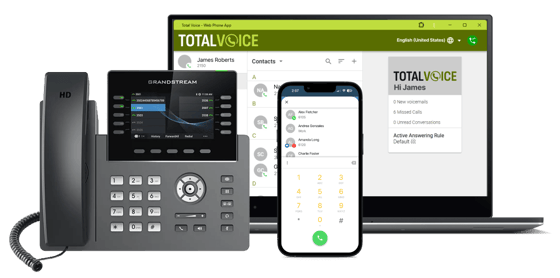
Cloud-based communication platform for voice, video, messaging, and collaboration
What Total Voice includes
Total Voice delivers Unified Communications as a Service, or UCaaS, which means the phone system runs in the cloud rather than on hardware in your building. Calling, collaboration, and administration come standard, with no third-party add-ons or separate licensing.
Cloud calling
Make and receive business calls from desk phones, computers, or mobile devices on one number. HD audio, SIP trunking, and STIR/SHAKEN caller ID authentication come standard.
Video meetings
Host video meetings with screen sharing, recording, and calendar scheduling. Active speaker view and remote storage for recordings come built in.
Team messaging and business SMS
Run internal chat by team or topic, and send SMS or MMS from your business number. Group chat and media sharing keep work conversations separate from personal.
Mobile work
A softphone app for iOS and Android puts a full extension on every employee's phone.
Auto-attendant and call routing
Dial-by-name directories, multi-language IVR menus, configurable timeouts, and routing rules answer calls professionally without a dedicated receptionist.
Call queues and contact center features
Ring all, round robin, linear hunt, and cascade routing handle inbound volume. Real-time queue stats, agent dashboards, and cradle-to-grave reporting give supervisors operational visibility.
Voicemail, recording, and analytics
Voicemail-to-email delivery, optional call recording with mid-call PCI redaction, and real-time dashboards for call volume, wait times, and agent performance.
Faxing, conferencing, and paging
Send and receive fax over IP, host dedicated conference bridges with PIN-based access, and run handset or overhead paging from the same platform.
Want to compare the cost of your current setup? Answer a few questions about your environment and communication needs to get estimated Total Voice pricing in under five minutes.
What Total Voice replaces
Most businesses move to Total Voice to consolidate the cost and complexity of running several communication tools at once. Here is the stack Total Voice typically absorbs into one monthly per-user fee.
| What businesses pay for separately | Included with Total Voice |
| Legacy PBX (plus annual maintenance) | |
| Zoom, GoTo Meeting, similar video tool | |
| Business texting tool (or personal cell) | |
| eFax service or fax machine | |
| Conference bridge or dial-in service | |
| Phone, long distance, and SIP trunk bills |
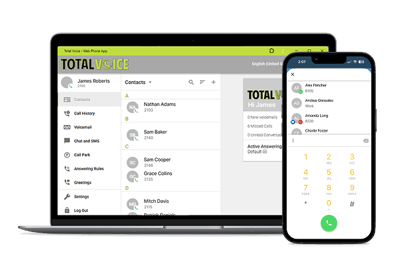
Calling that follows the user
Every employee gets the same calling experience at a desk, on a laptop at home, or on a phone in the field. Calls route through the cloud, so a power or internet outage at your office does not take the business off the phone.
- Same number and same features across desk, desktop, and mobile
- Automatic failover to mobile during a local outage
- Multi-site routing and number portability across locations
- Location-based 911 for office, remote, and mobile users
- Outbound caller ID authentication to reduce spam-flagging
What Total Voice costs
Total Voice is priced per user per month, with features included rather than sold as tiers. You can get an estimate in about five minutes by answering a few questions about your users, locations, and current setup. No sales call is required to see a number.
Local U.S. voice specialists on every support call
Total Voice is fully managed by our U.S.-based voice team. When a client calls support, a real telephony specialist answers, and that specialist already knows the environment.
Many national UCaaS providers have moved toward AI-first routing and offshore support. We run a different model. The same team that planned and deployed the system stays involved through ongoing administration, moves and changes, and day-to-day support.
- 35+ years supporting business voice systems
- 300+ years of combined IT experience across the team
- Direct phone access to a real technician, not a queue
- The same person who knows your system answers your next call
How a move to Total Voice works
Total Voice is delivered as a managed service. We handle planning through ongoing administration, so the move happens on a defined schedule rather than being figured out along the way.
- Plan: Environment review, number inventory, location and user mapping, routing requirements, and 911 configuration before any change goes live.
- Provision and port: Number porting, device provisioning, user setup, and location-based emergency calling configuration on a defined schedule.
- Cut over: Phased or full cutover with training, documentation, and live go-live support so users start the day with a working system.
- Run: Ongoing administration, moves and changes, technical support, and quarterly reviews to align the system with how the business is changing.

Common questions about Total Voice
Total Voice pricing depends on the size and needs of your environment, including your users, equipment, locations, and required features. Our quote tool asks a few questions about your setup and provides estimated pricing in under five minutes.
The estimate gives you a practical starting point and we'll confirm final pricing after reviewing your environment and implementation requirements.
Yes. Number porting is part of every Total Voice deployment. We handle the porting paperwork, coordinate with the previous carrier, and schedule the cutover so the move happens without interrupting business calls.
Calls route through the cloud, so a local outage does not take the business offline. Calls automatically forward to mobile devices or other configured destinations, and voicemail still captures missed calls until the office is back online.
Yes. Total Voice can coexist with Microsoft Teams, allowing teams that already use Teams for chat and meetings to keep using it while Total Voice handles business telephony, call routing, voicemail, and mobile calling across the organization.
The key difference is that Teams is collaboration-first, while Total Voice is built as a managed UCaaS phone platform. If you are comparing VoIP, cloud voice, Teams Phone, and UCaaS, this breakdown explains how business voice has evolved and where each option fits.
Total Voice runs on the Crexendo NetSapiens platform, one of the fastest growing UCaaS platforms in North America. Inzo delivers and manages it as a fully supported service. Clients work with Inzo Technologies directly for setup, support, and changes.
Business phone proposals can get acronym-heavy quickly. Our Managed Services Glossary defines common voice terms like VoIP, UCaaS, SIP, softphone, IVR, number porting, and E911 in plain English, so you can compare systems and understand what each feature actually does.
Yes. Call recording, mid-call PCI redaction, encrypted voicemail-to-email, and Business Associate Agreements (BAAs) are all available. We can help configure recording policy, retention, and access controls to align with HIPAA, FINRA, or SEC requirements where applicable.
Total Voice works with SIP-compatible desk phones from major manufacturers, dedicated softphone apps for Windows and Mac, and mobile apps for iOS and Android. Existing business phones from manufacturers such as Polycom, Yealink, and Cisco may be reconfigured for the platform.
During planning, we'll verify compatibility and recommend replacement hardware where needed. And if you need to purchase all your hardware, we can help you with that!
See what Total Voice could cost for your business
Get estimated pricing based on a few details about your current environment and communication needs. Or, request a no-obligation consultation for any and all questions.