Healthcare IT and Technology Integration, St. Louis and the Midwest
Healthcare technology integration connects the systems that alert care teams, locate equipment and help staff communicate across a facility. We plan, deploy, and support the hospital communication systems behind care delivery, including nurse call, access control, wander management, RTLS, telehealth, and wireless phones.
One integrator for the hospital communication systems behind care
Healthcare environments rely on more than one system to keep care moving. Patient calls, room status, staff communication, location visibility, wandering protection, access control, and virtual care technology all affect response time, staff efficiency, and the patient experience.
Inzo Technologies helps bring those systems together. We work with healthcare organizations to evaluate needs, recommend the right-fit solutions, manage deployment, and provide ongoing support so the technology works the way the environment needs it to.
Managed IT for medical practices and multi-location healthcare teams
Medical practices and healthcare organizations need a clear support boundary between business IT and specialist clinical systems. Inzo’s healthcare IT services include network infrastructure, cybersecurity, backup and recovery, and managed support alongside its healthcare technology work.
When comparing support, document the users, locations, devices and applications in scope. Identify who handles everyday requests, who coordinates with clinical software vendors, and who owns a problem that crosses systems. For multiple locations, ask how access, device inventories and escalation contacts will stay consistent as staff and sites change.
Use our IT provider-selection checklist to compare written coverage and responsibilities.
Benefits of managed IT services for healthcare teams
Managed IT puts day-to-day support, security upkeep and backups with one team, so clinical and office staff can stay on their own work. For a medical practice or a multi-location healthcare organization, that means:
- Help without hourly charges. Staff call, email or open a ticket and get help without hourly charges or block-hour agreements, because support is included in the monthly service.
- Security upkeep on a schedule. We patch operating systems and supported applications on a consistent schedule, and mobile device management enforces screen locks, encryption and remote wipe on phones and tablets.
- Clear access from hire to exit. New staff get a ready device and the correct access on day one, and we revoke access when people leave.
- Problems caught early. We monitor disk, memory, services and critical events on every managed device, and we verify backups and test restores.
- Room to grow. When you add staff, open a location or bring on new tools, coverage adjusts without a new contract negotiation.
These safeguards support a covered organization’s HIPAA program. They do not make the organization compliant on their own; the HIPAA question in the FAQ below explains the division of responsibility.
Healthcare backup and recovery: questions to ask before an outage
A backup schedule alone does not tell a healthcare organization how work will resume. Ask the IT team and application vendors to document:
- Which systems and data are backed up, and which depend on a separate vendor’s recovery process.
- When a restore was last tested, what was restored, and what the results showed.
- Which applications depend on identity services, network connectivity or another system being available first.
- Who can authorize recovery, who contacts each vendor, and how staff receive updates.
- What recovery time and acceptable data-loss targets leadership has agreed, and whether testing supports them.
Keep these records with the organization’s continuity plan. Clinical leaders and qualified system specialists should determine patient-care downtime procedures and any requirements for clinical or life-safety equipment. Explore Inzo’s data protection and recovery services to discuss the business IT part of that plan.
Healthcare technology solutions built around your environment
We help you identify what fits, what integrates well, and what will actually improve day-to-day operations.
-
Nurse Call Systems
Improve patient-to-staff communication with nurse call systems designed to support faster response, better routing, and clearer unit visibility.
-
Wander Management
Help protect at-risk residents with technology that improves awareness and shortens staff response time.
-
RTLS & Location Visibility
Improve visibility into staff, assets, and workflow events to support faster response and stronger operational efficiency.
-
Access Control & Healthcare Security
Support safer facilities and more controlled access to sensitive areas without creating unnecessary friction for staff.
-
Virtual Care & Telehealth Support
Support patient communication and care workflows with technology that helps virtual care operate more smoothly.
-
Wireless Phones & Mobile Communication
Keep staff connected across units, departments, and facilities with communication tools that reduce delays and improve coordination.
Also available: synchronized clocks, maglocks, and related integrated systems.
Why healthcare organizations work with Inzo Technologies
Inzo supports healthcare technology from planning and deployment through training and ongoing service. Our nurse call work includes West-Com distribution in Missouri, Illinois, Kansas, Iowa and Indiana. Explore our nurse call systems and regional coverage.
Existing healthcare clients describe that support in their own words:
“Greg is great to work with! Didn't take long to get everything up and running again.”
— C. B., Hospital in Illinois
Read more feedback from healthcare teams. For a new project, bring the installed-system inventory, support contacts and the workflows you want to improve so the conversation starts with your actual environment.
- Proven regional experience: We’ve worked with dozens of healthcare facilities across the Midwest for decades.
- Broader technical depth: With over 300 years of collective IT experience, our team understands how healthcare technology connects with the wider IT, security, and communication environment.
- One accountable partner: We support planning, deployment, training, and ongoing service with one team.
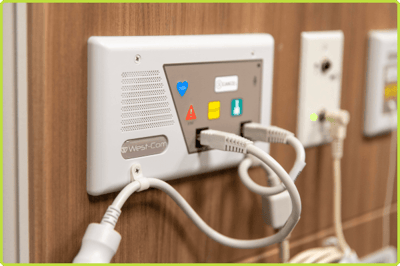
Managed IT services for healthcare organizations in St. Louis and across the Midwest
Clinical systems run on hospital networks, servers, and security controls. Inzo Technologies has served organizations since 1989 and supports both layers for healthcare facilities across the Midwest from our headquarters in Chesterfield, in St. Louis County. Our managed IT services for healthcare organizations cover:
- Network infrastructure that nurse call, RTLS, access control, and EMR or EHR access depend on
- Cybersecurity with layered protection and, for clients with our security service, around-the-clock monitoring by a Security Operations Center
- Backup and recovery with verified backups and tested restores
- Managed support with help desk and proactive monitoring
- Protecting electronic health records and patient data with the technical safeguards the HIPAA Security Rule calls for, such as access controls, encryption, verified backups and audit logging
Facilities work with one team for clinical technology and the infrastructure under it. For HIPAA-covered organizations, see what HIPAA requires for patching.
Buying a practice? See IT due diligence for healthcare acquisitions.
Healthcare Acquisition Technology Checklist: Nurse Call, Wander Management and IT Risks
A healthcare acquisition can include clinical communication and resident-safety systems alongside business IT. Before close, establish what is installed, who supports it and what evidence is available. Use this checklist to request records and identify questions for the facility’s clinical, technical and life-safety specialists.
This is a diligence records checklist, not an installation specification, testing procedure or certification of compliance. Requirements and system behavior depend on the care setting, installed equipment and applicable requirements. Qualified specialists should assess those details before changes or testing are planned.
Nurse call and emergency call systems
- Inventory and support: request the manufacturer, model, software version, installation date, device inventory, support status and parts availability for each system.
- System documentation: request current drawings, manufacturer documentation, listing or certification records and details of additions or substitutions. Have a qualified specialist confirm their applicability to the installed system and care setting.
- Coverage and condition: request the documented coverage plan, latest inspection or test reports, open defects and records of devices that are out of service. Ask who has assessed the system against the facility’s requirements.
- Alert routing and workflow: document where calls go, how escalation is configured, what staff are trained to do and who owns configuration changes. Ask for records of staff training and approved downtime procedures.
- Interfaces and history: list any connections to clinical records, patient admission feeds, beds, staff directories, location systems or mobile devices. Identify the support owner for each interface and the availability and retention of operational logs.
- Contracts: review support agreements, licenses, renewal dates, transfer conditions and any known upgrade or replacement recommendations.
Wander management and related door systems
- Installed scope: request system inventories and drawings showing monitored areas and interfaces with door hardware, access control or other building systems.
- Documented operation: request the approved sequence of operation, acceptance records and recent inspection or test reports. Have the facility’s qualified life-safety and system specialists review egress, emergency operation and connected-system behavior. Do not infer how a door should operate from a generic checklist.
- Devices and response: request tag or transmitter inventories, maintenance records, alarm-routing documentation and staff response procedures, where applicable.
- Open findings: ask for a de-identified summary of relevant incidents, unresolved defects, inspection findings and corrective actions through the deal’s authorized review process.
Supporting IT, power and data
- Dependencies: document the networks, servers, interfaces and power arrangements each system relies on, with the responsible vendor and facility owner.
- Continuity: request maintenance and test records for documented backup-power and recovery arrangements. Have qualified teams identify gaps and plan any further testing with clinical operations.
- Access: identify administrative and vendor remote access, account ownership and the process for transferring authorized access without disrupting care or support.
- Information handling: identify what patient or resident information each system uses, who can access it and how it is retained. Ask the facility’s privacy or compliance lead to review vendor obligations and applicable agreements. Do not include patient records in an ordinary marketing inquiry.
Turn unanswered questions into a deal plan
For each gap, record the evidence requested, the responsible owner, the potential operational impact and the next review date. Missing records or unsupported components warrant further assessment; they do not, by themselves, establish that an entire system must be replaced. Obtain a qualified assessment and scoped cost estimate before putting remediation or replacement costs into the acquisition plan.
Connect these findings with IT due diligence for healthcare acquisitions and your post-acquisition stabilization plan. Learn more about Inzo’s nurse call services.
What should buyers request when reviewing a facility’s nurse call and wander management systems?
Start with inventories, current drawings, manufacturer and certification records, support contracts, inspection and test reports, open defects, alarm-routing documentation and staff downtime procedures. Have the facility’s qualified clinical, technical and life-safety specialists interpret those records for the installed systems and care setting before defining corrective work.
Built for a range of healthcare environments
We support technology initiatives across multiple care settings:
Acute Care
Support faster communication, clearer workflow visibility, and better coordination across departments and units.
Critical Access Hospitals
Help smaller facilities modernize patient communication and related workflows with practical, supportable solutions.
Clinics & Ambulatory Care
Improve patient flow, staff communication, and the care experience in fast-moving outpatient environments.
Post-Acute & Senior Living
Support resident safety, staff responsiveness, and more consistent care communication in long-term and transitional care settings.
Nurse call is often the starting point
For many facilities, nurse call is the core communication layer behind faster response, clearer alerting, and more consistent care workflows.
As a West-Com distributor serving Missouri, Illinois, Kansas, Iowa and Indiana, Inzo Technologies delivers nurse call solutions with one accountable team for design, deployment, training, and long-term support. For organizations evaluating patient-to-staff communication improvements, nurse call is often the most immediate place to start.
Technology works better when it works together
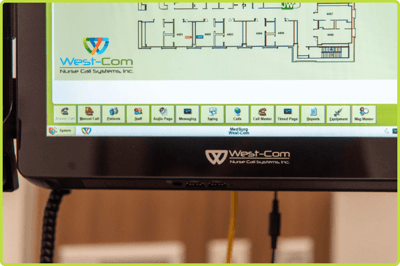
Connected systems give care teams one current picture of what is happening. Depending on the solution and environment, healthcare technology can connect with EMR or EHR systems, ADT feeds, hospital beds, staff directories, RTLS, staff scheduling, and mobile devices to support better communication and more actionable workflows.
The goal: better visibility, fewer manual workarounds, and technology that fits the way care teams actually operate.
Trusted by healthcare teams across the Midwest
Matt was able to tell me what equipment was not responding and after restarting the switch that had the uplink everything started worked.
Inzo is always ready to help and does so professionally!
Greg is great to work with! Didn't take long to get everything up and running again.
Lewis is always so cheerful and happy to help problem solve any issues - never makes me feel dumb for calling!
Ready to join dozens of other healthcare facilities?
Outcomes healthcare leaders actually care about
Faster response & clearer routing
Help requests reach the right caregiver faster and reduce confusion around who should respond.
Better staff efficiency
Reduce avoidable friction, manual workarounds, and communication gaps that slow teams down.
Safer environments
Support patient and resident safety with systems designed around visibility, control, and timely alerts.
Stronger operational clarity
Improve reporting, workflow awareness, and cross-team communication with better-connected systems.
Common questions about healthcare technology
A healthcare technology integrator helps healthcare organizations evaluate, deploy, connect, and support the systems that improve communication, safety, and operational workflows across the care environment.
Inzo supports nurse call, wander management, RTLS, access control, healthcare security, synchronized clocks, virtual care support, wireless phones, and related systems that help facilities improve communication and coordination.
The right technology can help route alerts more clearly, improve team communication, reduce manual workarounds, increase visibility, and support faster response across the facility.
Inzo works with a range of healthcare environments, including hospitals, critical access hospitals, clinics, ambulatory care, senior living, skilled nursing, and post-acute care settings.
A nurse call system helps patients or residents request assistance and helps staff receive, route, and respond to those requests more efficiently. Learn more about nurse call systems.
Healthcare organizations choose Inzo for practical guidance, end-to-end support, and regional experience. We have worked with dozens of facilities across the Midwest for decades, backed by 300 years of collective IT experience, and supported by broader capabilities in cybersecurity and managed IT, and voice.
Yes. Inzo helps with planning, implementation, training, and ongoing support so facilities have one accountable partner from evaluation through long-term use.
HIPAA compliance is the covered organization’s responsibility, and no IT provider can make an organization compliant on its own. A managed IT provider supports it with technical safeguards such as access controls, encryption, backups and audit logging. The HIPAA Security Rule requires covered entities to perform a risk analysis, so ask any provider what it contributes to that analysis and what documentation you receive. Your privacy or compliance lead decides which requirements apply to your organization.
Electronic health record (EHR) access depends on the network, servers and workstations underneath it, and Inzo manages all three. We watch the health of every managed device and server in real time, a U.S.-based Network Operations Center monitors the network around the clock, and backups are verified and recovery is tested so an outage or ransomware event does not take patient records down with it. The same team that manages the network also supports nurse call, so clinical systems and records systems are not split between vendors. When a problem needs hands on equipment, our own technicians come onsite across the St. Louis metro, eastern Missouri and southern Illinois.
Prepare a record of the existing system, supported equipment, service history, vendor contacts and the areas the facility wants reviewed. Identify who owns the project and ongoing support, and bring the facility’s clinical, security, technical and life-safety specialists into planning. Ask the proposed provider to document the survey, integration, training and maintenance scope. System design, door behavior and applicable requirements need qualified specialist review for the specific facility; a general checklist does not establish compliance.
Let’s review what's creating friction in your environment
Whether you are evaluating nurse call, planning a facility upgrade, or looking at a broader communication and safety initiative, we can help you identify the next step.