 Jordan Richter
7 Signs Your Business Needs Managed IT and Cybersecurity
Still calling IT only when something breaks? Here are 7 signs your St. Louis business needs managed IT and cybersecurity, and what changes after.
Your CFO sends a message. It's Friday afternoon, there's a vendor payment due, and the wording sounds just like her. The email address looks right. The tone is right. The urgency is familiar.
Except she didn't send it.
This post covers what generative AI is doing to Business Email Compromise (BEC) attacks, why small businesses are a primary target, and what you can actually do to reduce your exposure.
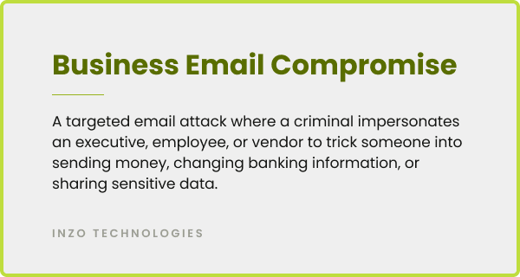
BEC is a category of fraud where attackers impersonate a trusted person—usually an executive, vendor, or employee—to trick someone into wiring money, sharing credentials, or changing payment details. No malware required. No suspicious attachments. Just a convincing email.
The FBI's Internet Crime Complaint Center (IC3) consistently ranks BEC among the costliest cybercrime categories year over year, with billions in reported losses annually. Unlike ransomware, BEC often goes undetected until the money is already gone. Source: 2025 IC3 Annual Report.
For a 30-person manufacturing company or a regional healthcare practice, a single successful BEC attack can mean a five or six-figure loss with little recourse.
For years, phishing emails were easy to spot: clunky grammar, odd phrasing, generic greetings. Employees learned to look for those signals. Generative AI has largely eliminated them.
Attackers now use large language models (LLMs) like ChatGPT and Claude to craft emails that are contextually aware, grammatically flawless, and tonally matched to their target. Here's what that looks like in practice:
Hyper-personalized lures. AI tools can scrape a company's LinkedIn page, website, press releases, and public social posts to build a detailed profile of your organization. Within minutes, an attacker has enough context to reference your recent office move, your new hire, or your fiscal quarter.
Voice and tone matching. If your CEO posts on LinkedIn regularly or your company shares newsletters publicly, that content trains an AI to mimic their communication style. The result sounds like the real person because it's been modeled on them.
Scaled spear-phishing. Spear-phishing, meaning targeted, personalized attacks, used to require significant manual effort. AI automation means attackers can now run hundreds of personalized campaigns simultaneously. Volume plus personalization is a dangerous combination.
Deepfake audio and video. BEC has expanded beyond email. Attackers are using AI-generated voice clones to make phone calls that "confirm" a fraudulent wire transfer. Some organizations have reported receiving video calls using deepfaked executives.
The friction that once slowed attackers down is gone.
Larger enterprises have dedicated security teams, multi-step wire transfer approvals, and tooling built specifically to catch BEC attempts. Most small businesses do not.
The realistic picture for a 30-person company often looks like this: one person handles accounts payable, approvals happen over email, and the culture is built on trust and speed. That's not a criticism; it's just how lean teams operate. Attackers know this.
Small businesses also tend to have less mature email security configurations. Controls like DMARC (Domain-based Message Authentication, Reporting, and Conformance), DKIM (DomainKeys Identified Mail), and SPF (Sender Policy Framework) are not always properly configured, which makes it easier to spoof a domain or closely impersonate one.
Your vendors and partners are an extension of your risk surface, too. If a vendor's email gets compromised, an attacker can carry on a legitimate existing email thread with your team, changing payment instructions mid-conversation. This is called vendor email compromise, and it's increasingly common.
This does not require a large security budget. It requires deliberate process and a few technical controls.
Configure your email authentication records properly. DMARC, DKIM, and SPF are the baseline. If your IT provider hasn't verified these are correctly set and enforced, that's a starting point. DMARC in particular can prevent external parties from spoofing your domain.
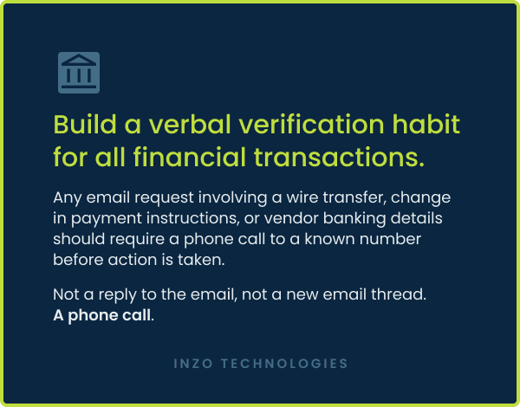
Build a verbal verification habit for financial transactions. Any email request involving a wire transfer, change in payment instructions, or vendor banking details should require a phone call to a known number before action is taken. Not a reply to the email, not a new email thread. A phone call. This one process change stops a significant percentage of BEC attempts.
Train your team on AI-enhanced phishing specifically. General security awareness training is good. Training that specifically addresses what AI-generated emails look and sound like is better. The "bad grammar" signal is gone. Employees need updated mental models for what suspicious looks like now.
Implement multi-factor authentication (MFA) across all email accounts. If an attacker can't get into an email account in the first place, their ability to execute a thread hijack drops significantly. MFA is not optional at this point.
Review your financial approval workflows. If one person can authorize and execute a wire transfer without a secondary approval, that's a structural vulnerability worth addressing. Separation of duties in financial processes is a basic but powerful control.
Evaluate your email security tooling. Modern email security platforms use AI-based analysis to flag anomalies in sender behavior, email headers, and content. If you're relying on default spam filters, you're under-protected.
Need a plain-English refresher on terms like BEC, phishing, and MFA? We keep those definitions in our Managed Services Glossary so your team can understand the risk without getting stuck in cybersecurity jargon.
Pull up your email authentication records and check your DMARC, DKIM, and SPF configuration. If your DMARC policy is set to "none," your domain is not protected against spoofing. That's the first thing to fix.
Then have a conversation with whoever handles accounts payable. Ask them: "If you got an email from me asking to change a vendor's bank account information, what would you do?" Their answer will tell you a lot about where your process gaps are.
BEC attacks succeed because they exploit trust and speed. Slowing down on financial decisions and verifying out-of-band are low-cost, high-impact habits that make your organization a harder target.
If you want a second set of eyes on your email security posture or your current controls, let's have a quick chat. No pitch or obligation, just a straightforward conversation about where you stand and what, if anything, needs attention.