 Jordan Richter
4 min read
How Business Voice Evolved From VoIP to UCaaS
You bought a phone system back when the rep showed up with a binder, paid extra for a "VoIP" plan a few years later, and now your team mostly talks...
A conveyor stops on the second shift. The line lead radios maintenance, maintenance calls whoever handles IT, and forty minutes pass before anyone can say whether the problem sits in a switch, a sensor, or the equipment itself.
Real-time network monitoring closes that forty-minute gap.
This post looks at why manufacturing networks build up blind spots over time, what real-time network monitoring actually shows you, and how that visibility protects both uptime and your next audit.
A recent global survey found that 6 in 10 manufacturers experienced unplanned downtime in the past year, with outages in some sectors averaging more than a million dollars per hour and weekly losses across the industry reaching into the hundreds of millions. (Fluke, 2025) Your plant will not see numbers that large, but the math scales the same way. Every hour a line sits idle still means idle labor, missed delivery windows, and a customer asking why their order is late.
Most of these outages trace back to something mundane rather than a dramatic equipment failure; a misconfigured switch, a failed network card, or a firmware update that breaks a connection between two systems can bring a line to a stop just as effectively as a broken motor. Without visibility into the network itself, every one of those problems looks the same from the production floor: it just looks like the line is down.
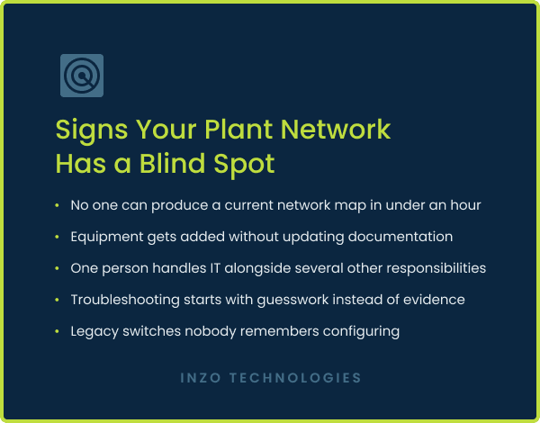
Manufacturing networks grow in layers over years. A new line comes online, a vendor installs a piece of equipment with its own network connection, and the documentation never quite catches up. Most plants run a mix of operational technology (OT), the equipment-level systems that run machines and sensors, alongside standard IT infrastructure like servers, switches, and Wi-Fi.
Add programmable logic controllers (PLCs) running the equipment, Internet of Things (IoT) sensors collecting machine data, and a handful of legacy switches nobody wants to touch because nobody remembers what depends on them, and you get a network that is hard to troubleshoot under pressure. Most manufacturers in this position do not have a dedicated network engineer on staff. One or two people often handle IT alongside several other responsibilities, so problems tend to surface only after they have already affected production.
Modern monitoring tools solve this by building a live map of everything connected to the network. They automatically discover switches, firewalls, routers, and many IoT devices the moment those devices connect, without manual data entry. The map updates itself as the network changes, so it stays accurate as new equipment goes in on the floor.
Every device gets its own dashboard showing health, performance, and recent activity. When a problem happens, you can see immediately whether it traces back to a configuration issue, a hardware failure, or simply heavy traffic from a system pulling more bandwidth than expected. Built-in alerts flag unusual behavior automatically, often before anyone on the floor notices anything is wrong, and you can tune those alerts to focus on what is actually critical so the volume stays manageable. When this kind of monitoring runs through your managed IT provider, those alerts land with someone who already knows your environment and can act immediately, day or night, instead of waiting for a call after the line has already stopped.
Customer quality audits, cybersecurity questionnaires from manufacturing partners, and standard certifications all eventually touch the network, and gaps in documentation tend to surface at the worst possible time: mid-audit.
Real-time monitoring tools keep a running history of configuration changes, so you can show exactly what changed, when it changed, and who made the change. That kind of record turns a multi-day scramble into a quick, defensible export, and it gives you a clear answer the next time a customer or insurer asks how you track changes to your production network.
You do not need new hardware to find out where you stand. Ask whoever manages your network for a current device inventory and a network map. If they can produce one in minutes, your network is in solid shape. If it takes days, or the map is months out of date, you have already found your first blind spot, and it is worth documenting before it costs you a shift.
If you are not sure what is actually running on your plant floor network, or you want a second set of eyes on it, let's have a quick conversation. It is a 15-minute, no-pitch session focused on understanding your setup and whether better visibility would help your operation.
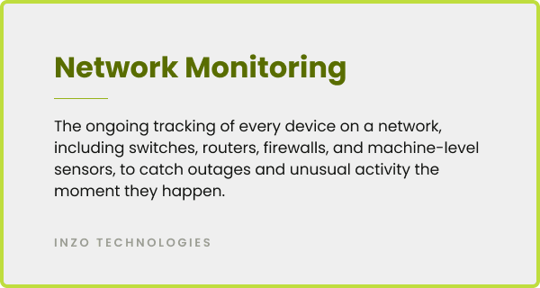
Network monitoring is the ongoing tracking of every device connected to a network, including switches, routers, firewalls, and increasingly machine-level sensors. It catches outages, unusual traffic, and configuration changes as they happen instead of after someone on the floor reports that something is wrong.
Network monitoring focuses on uptime, performance, and connectivity. Cybersecurity monitoring focuses on threats like unauthorized access or malware. The same visibility into your network supports both, since spotting a security issue gets much harder when you cannot see everything connected to the network in the first place.
Smaller manufacturers often run leaner teams with no backup if something goes wrong, which makes visibility especially valuable. A 40-person plant with one person handling IT alongside other duties has just as much riding on its network as a much larger facility, with far less margin to absorb a surprise outage.
Most modern monitoring platforms can map a facility's network within hours rather than weeks. The tools typically install through lightweight software rather than new hardware, so a plant can go from limited visibility to a full network map in a single afternoon.