 Jordan Richter
Why Annual Security Training Fails Small Businesses
Annual security awareness training leaves employees unprepared for 48 weeks of the year. Here's why managed, ongoing training works better.
You bought a phone system back when the rep showed up with a binder, paid extra for a "VoIP" plan a few years later, and now your team mostly talks through Teams chats and the occasional call that drops when the office WiFi blinks. Somewhere along the way, "the phones" stopped being one thing.
This post walks through what VoIP, cloud voice, and unified communications actually are, where UCaaS fits as a delivery model, and why the distinction matters when you are deciding what to pay for and who to hold accountable when something breaks.
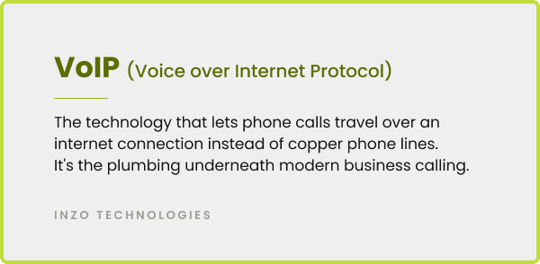
VoIP stands for Voice over Internet Protocol. It is the underlying technology that lets a phone call travel over an internet connection instead of the copper lines that used to run from a phone company switch into your building. VoIP is the transport method, the plumbing that carries voice as data.
The shift from copper to VoIP unlocked two things businesses cared about: lower per-line costs and the ability to plug calling into other systems. A call became data, and data could be routed, recorded, and routed again. Early VoIP setups still had a physical box somewhere on-site, a PBX (private branch exchange), that managed extensions, voicemail, and call routing. If the box failed, so did the phones.
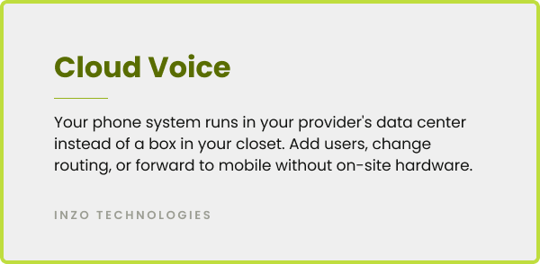
Cloud voice is what happens when that PBX leaves your closet. Instead of buying and maintaining a piece of hardware that handles your call routing, you subscribe to a service where the provider hosts the system in their data center. Your phones, or softphones running on a laptop, register to the cloud, and calls route through it.
The benefits here are practical for businesses: You stop paying to maintain hardware that ages out every five to seven years. You can add or remove users without scheduling a technician on-site. Power goes out at the office and calls forward to mobile devices automatically. For a long time, cloud voice was the destination most SMBs were trying to reach.
Cloud voice solved the phone system problem. Unified communications, or UC, solved a bigger one: most teams do not just call each other. They video conference, message, text, share files, and route customer conversations across all of those channels in the same workday.
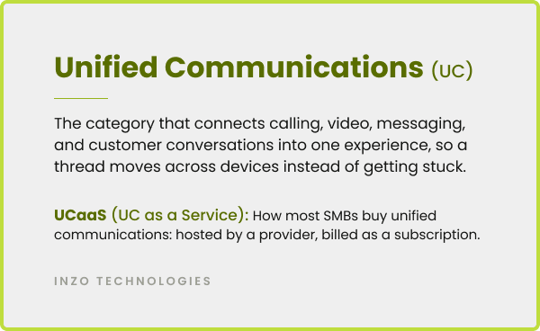
Unified communications is the category of technology that brings voice, video, team messaging, SMS, presence (knowing if a coworker is available), and contact center features into one connected experience.
The point of UC is that a conversation does not get trapped in a single channel. Your salesperson takes a call on their cell while driving, walks into the office, and the same conversation continues on their laptop. The receptionist sees who is on the phone before transferring. A customer texts your main business number and the message lands in a queue your team can actually answer.
UC is the category. UCaaS, Unified Communications as a Service, is the delivery model where a provider hosts the whole platform in the cloud and you subscribe to it. You can also run unified communications on-premise, and some organizations still do for specific reasons like nurse call integration in healthcare. For a small or medium-sized business that does not want to staff and maintain a communications stack, the cloud-delivered version is almost always the right call.
That consolidation is the real value: one platform, one bill, one set of integrations to your CRM and email, one team to call when something breaks. You can see how this fits into our communications offering here.
This is where most decision-makers get understandably stuck. Teams and Google Workspace both have chat, video, and some form of calling. So aren't they already unified communications?
There is real overlap, and the difference matters financially and operationally. Teams and Google Workspace are collaboration-first platforms that added voice as a feature. To actually make and receive calls to the outside world from Teams, you need Microsoft's Teams Phone licensing plus either a Microsoft calling plan or what is called Direct Routing through a third-party voice provider. Google Voice has similar add-on dynamics. Out of the box, neither one delivers the things a phone system has to do: auto-attendants, call queues, hunt groups, paging, business-grade SLAs (service level agreements) on call quality, E911 location services, regulatory call recording, and integrations with industry-specific tools like nurse call platforms or dispatch software.
A purpose-built UCaaS platform handles all of that natively. And in many cases, the right answer for a business already standardized on Microsoft 365 is a UCaaS provider that integrates directly with Teams, so your team gets the Teams interface they already know with a real voice platform underneath. The collaboration tool stays. The phone system gets serious.
Industry guidance from groups like the FCC on business VoIP is a good reminder that voice service still carries regulatory weight that collaboration suites alone do not address.
If your current setup is a mix of an aging on-prem PBX, a few VoIP lines from a regional carrier, Teams for internal chat, a separate video tool, and a cell phone reimbursement program, you are not alone. You are also paying for overlap and absorbing the friction of every system that does not talk to the others.
The practical takeaway: pull your last three telecom and software invoices and write down every line item related to phones, video, messaging, conferencing, and contact center. If you cannot get to the total in under ten minutes, your communications stack has outgrown the way it was bought.
The right question now is which platform can consolidate the channels your team actually uses, integrate with the business systems you already rely on, and give you one accountable partner when something goes wrong. That is the shift from buying phone service to buying a communications platform.
If you are not sure whether what you have today is VoIP, cloud voice, or genuine unified communications, take a look at Total Voice, our UCaaS platform built for small and mid-sized businesses. If you would rather just walk through what you have today and what would actually serve you better, let's have a 15-minute conversation. We'll spend a few minutes mapping what you have today against what your team actually uses, and you'll leave with a clearer picture of where the overlap and gaps are.