 Jordan Richter
7 Signs Your Business Needs Managed IT and Cybersecurity
Still calling IT only when something breaks? Here are 7 signs your St. Louis business needs managed IT and cybersecurity, and what changes after.
You've probably noticed the cybersecurity headlines getting louder this spring. One announcement in early April 2026 stood out enough that it pulled bank presidents, federal agencies, and the largest tech companies in the world into emergency meetings within days.
This post breaks down what happened, what it means for a business your size, and what a modern security setup needs to do about it.
In early April 2026, Anthropic, the company behind Claude AI, revealed a model called Claude Mythos Preview. It can find security flaws in software automatically, at a speed that wasn't possible before.
During testing, Mythos found vulnerabilities in every major operating system and web browser in use today, including flaws that had gone undetected for literal decades. It didn't just find them. It built working attacks from them. In cases Anthropic documented publicly, the entire process from discovery to deployable attack took hours. Expert penetration testers said the same work would have taken weeks.
Anthropic decided not to release Mythos to the public. Instead, they formed a closed group called Project Glasswing with about 50 organizations, including Microsoft, Google, Apple, and Cisco, to use the model on defense: finding and patching vulnerabilities before attackers can reach them.
Then, within the first week, Bloomberg reported that a small group of unauthorized users had already gained access to Mythos through a third-party vendor. They got in on the same day Anthropic made the public announcement, by guessing the model's location based on how Anthropic had structured past systems. Anthropic said it found no evidence its own systems were affected, but the incident made something clear: keeping a tool like this contained is harder than it looks.
Anthropic has been direct about one other thing: similar AI capabilities will emerge from other companies within 6 to 18 months.
That is the clock everyone is working against.
The thing that has always limited cyberattacks is human effort. Finding a flaw, building a working exploit, and launching an attack required skilled people and significant time. That constraint applied regardless of who the target was.
Mythos-class AI removes that constraint.
Vulnerability discovery and exploit development become automated and cheap. An attacker with access to tools like this can run campaigns against hundreds of businesses at once for nearly nothing. Organizations don't get picked because they're a big target or an easy one. They get hit because the cost of going after them drops to almost zero. Volume goes up across the board, for every business connected to the internet.
There's a second pressure point worth noting. Cyber insurance underwriters are already asking harder questions about AI-era controls at renewal time. The documentation that satisfied an auditor two years ago may not hold up this year. Tighter patch timelines, behavioral monitoring, and around-the-clock coverage are showing up in policy requirements.
Most SMB security setups today were built to recognize threats they've already seen. That worked well enough for a long time. It doesn't hold up when AI can generate new, never-before-seen attack code on demand. Here's what has to change.
Traditional antivirus (AV) works by comparing what it finds against a list of known threats. If the code is new, and AI-generated malware produces novel code by design, there's no match. The tool misses it.
Behavioral detection works differently. Instead of asking "have I seen this before," it asks "what is this process actually doing?" It watches for actions that signal something malicious: encrypting files at unusual speed, trying to access stored credentials, making unexpected outbound connections. It stops those behaviors whether or not the specific threat has ever been seen before. For AI-era attacks, this distinction matters more than anything else in your stack.
Knowing about a threat and stopping it are two different things. When attacks can complete in seconds, a setup that waits for a human to review an alert, make a decision, and take action is already too slow.
Autonomous response means the endpoint tool acts on its own. It isolates a compromised device, stops a malicious process, or rolls back changes without waiting for approval. That speed is what contains an incident before it spreads. Human oversight still matters, but it happens after the threat is stopped, not before.
Endpoint protection covers your devices. But attacks don't stay on one device. They move through your network, probe your identity systems, and look for gaps in your cloud environment and email. Monitoring all of those layers around the clock requires more than a person watching a dashboard.
AI-assisted monitoring uses automated analysis to sort through the noise, flag real threats, and pass the serious findings to human analysts who can act on them. That combination keeps alert volume manageable and response time fast. Attackers moving through a network often leave behavioral signals across multiple systems before any single alarm goes off. Connecting those signals is what catches them early.
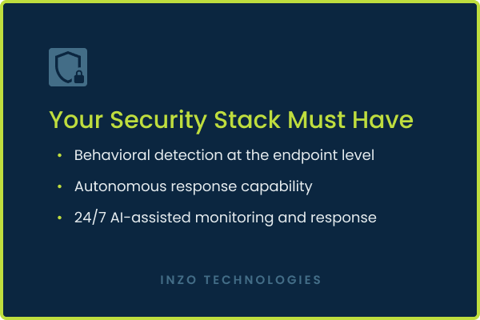
Our managed cybersecurity stack is built around this architecture: behavioral detection at the endpoint with autonomous response capability, layered with 24/7 AI-assisted monitoring across your full environment. If your business also relies on us for voice services, it's worth knowing: your phone infrastructure runs on the same network. A breach doesn't stay contained to the data side.
Knowing you have security tools in place and knowing whether they're the right ones are two different things. Most business leaders can't answer that question without help, and that's not on them. It's not something most providers explain clearly.
Inzo Technologies offers a complimentary cybersecurity stack review for businesses in the St. Louis region.
It's a focused assessment with our Director of Technology and Engineering, and it covers the areas that matter most right now, including endpoint protection, security monitoring and escalation, firewall and network infrastructure, patch and vulnerability management, backup and recovery readiness, identity and access controls.
After the review, you get a plain-English summary: which protections are working, where the gaps are, and which next steps matter most for your specific situation. No technical jargon, no obligation to act on anything. If you're already in good shape, the review confirms that. If there are gaps worth closing before the threat environment shifts further, you'll know exactly what they are and what it would take to address them.